
The recent post Recommitting to Training in Geriatrics by Dr. Langston does a great job exploring the paradox that as our population ages, fewer and fewer medical professionals pursue specialization and training in geriatric medicine. This is also true in my clinical specialty, psychiatry. During the 30 years since I completed training in psychiatry, the number of older Americans has nearly doubled while the number of psychiatrists who pursue training in geriatric psychiatry has been cut in half. This is not because of a lack of interest in psychiatry more broadly. In fact, psychiatry has become one of the most popular and most rapidly growing specialties for newly graduating physicians over the past decade. But today, only about 50 of the 1,500 physicians who graduate from psychiatry residency programs each year pursue additional training in geriatric psychiatry and fewer than half of the available positions in geriatric psychiatry training programs are filled each year.
Building the Field with a Geriatric Psychiatry Learning Collaborative
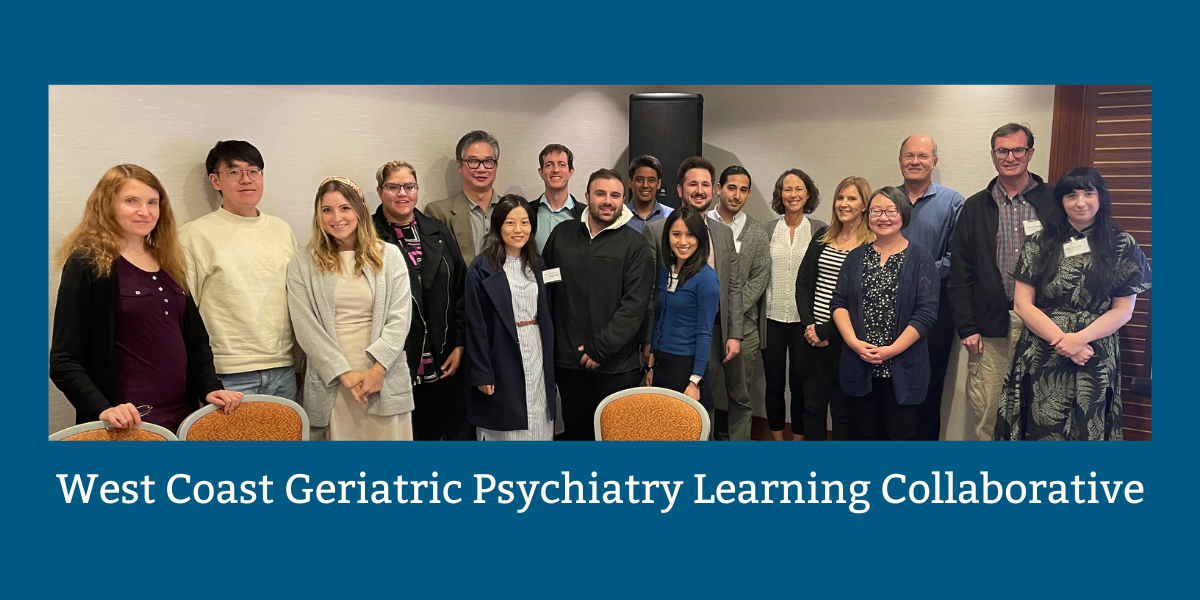
With support from Archstone Foundation, we recently convened program directors and fellows from all six geriatric psychiatry training programs on the West Coast to explore ways to increase recruitment and retention in the field of geriatric psychiatry. Our participants agreed with many of the reasons for the declining interest in geriatric medicine and psychiatry which are summarized in the excellent post by Dr. Langston. They also pointed out that in several medical specialties such as internal medicine, ophthalmology, or orthopedic surgery, older adults now make up the majority of patients seen during general residency training. Graduates from such training programs may feel that they have had sufficient exposure to older patients during their general residency training, but there is limited time and space in general psychiatry training to develop expertise in the core principles of gerontology, geriatric medicine, and geriatric psychiatry.
Solutions to Meet the Growing Need
Residents in general psychiatry training programs also point out that additional fellowship training in geriatric psychiatry comes at a substantial economic cost. The average trainee in geriatric psychiatry today is in his or her early 30s, a time when physicians are hoping to start families and establish themselves in practice. It is also a time when many feel the pressure to pay back hundreds of thousands of dollars in educational loans accumulated over a decade of training. For most, getting additional training in geriatrics not only won’t increase their salaries but it can also even be associated with lower incomes. Serious efforts to provide loan repayment or substantial financial stipends during the additional time to train in geriatric psychiatry might make it more attractive to pursue additional training in geriatric psychiatry.
Another solution discussed by our panel of aspiring geriatric psychiatrists is a recommendation to allow general psychiatry residents to ‘fast-track’ into geriatric psychiatry training programs the same way they can ‘fast track’ into training in child and adolescent psychiatry, a subspecialty of psychiatry that attracts more than 15 times as many psychiatry trainees each year than geriatric psychiatry.
But even if we were successful in doubling the number of physicians training in geriatric psychiatry from about 50 per year to 100 per year, we will never have enough geriatric specialists to meet the rapidly growing needs of our older population. Given that reality, we might be better off exploring ways in which we can better ‘leverage’ the skills of the few trained geriatricians we do have, perhaps by using them as trainers or clinical consultants, or to provide expert reviews and second opinions on challenging cases encountered in general medicine and in health care settings that serve older adults.
One example of such a new role is the role of a Psychiatric Consultant in a Collaborative Care program, a model that has been shown in dozens of studies to improve the health of older adults while saving overall health care costs. Archstone Foundation supported a successful adaptation of the collaborative care model that expanded its reach to include community-based organizations and family caregivers as part of the care team. Such new roles for geriatric specialists might make the practice of geriatric psychiatry more attractive and in turn, might motivate more psychiatry graduates to consider additional training in geriatric psychiatry.
Developing and supporting geriatric psychiatrists as role models in our academic health care systems might also pay great dividends. Several participants in our learning collaborative pointed out that for a medical student or a new psychiatrist in training, even just one experience of working with a geriatric psychiatrist who seems to love their patients, their colleagues, and their work is one of the most powerful motivators to choose a career in geriatric psychiatry.
Over the next year, our group of dedicated fellows and program directors from the six West Coast geriatric psychiatry training programs will explore these ideas and test what’s possible. We’ll use the power of working together to bring forward possible solutions to achieve better care and outcomes for older people.


Comments
We are very proud of the diversity of background and expertise that our Archstone Foundation board assembles. We are grateful to them all for their commitment to our mission and work.
The case of Geriatric Psychiatry is very interesting. The decline in people training for the geriatric psychiatry workforce is distinct from that in geriatric medicine (internal or family) because the specialization is suffering even as the general discipline is growing whereas to the extent that geriatric medicine is a cousin of primary care, it draws on a shrinking base. Even the financial issues are perhaps not as clear cut as one might think - because such a large share of children in the US are covered by the worst payer - Medicaid - choosing to go into child psychiatry can be economically challenging, even if one does have some control of one's patient mix. Medicare is usually a better payer than Medicaid, so we may really be seeing something more profound about attitudes towards children versus older people.
We would love to find ways to build up geriatric mental health skills among nurse practitioners, psychiatrists, PAs, social workers and all the other disciplines. There is no health without mental health.