We are pleased to introduce the six organizations receiving our most recent grants for capacity building, all of which are working to improve the lives of older Californians by integrating healthcare and social services.
Since 2019, Archstone Foundation has invited applications for these funds from any nonprofit in the state serving older adults or their caregivers and focused on care coordination. The grants aim to permanently shift their ability to serve client populations more effectively and efficiently.
The next opportunity to seek such a grant will be in July. With your input, we have continued to refine the application process to make the program as accessible and beneficial as possible. Consistent with our vision of equitable coordinated care, with our upcoming call for proposals we will be exclusively supporting programs serving communities that have historically been or are currently underserved. Our shortened application calls for organizations to explain how they are focusing on equity and reducing health disparities.
Meet the 2024 Grantees
The California Food is Medicine Coalition is eight community-based organizations that provide medically tailored meals and medical nutrition therapy services for people with health conditions. Members have contracts with Medi-Cal managed care plans to provide meals as part of the California Advancing and Innovating in Medi-Cal (CalAIM) initiative. The grant will support training so registered dietitians and registered dietitian nutritionists can improve the quality of their care and their nutrition coordination for older adults with complex health issues and unique needs. Doing so will strengthen the organizations’ ability to contract with and be reimbursed by Medicare, Medicare Advantage, and Medi-Cal for providing medical nutrition therapy services.
Vital Access Care Foundation (VACF) of Fountain Valley will use its grant to enhance the infrastructure and operational capacity of its Asian Pacific Islander Task Force’s Direct Care Network to deliver culturally competent and client-centered direct care to older members of Southern California’s Asian American, Native Hawaiian, and Pacific Islander communities. The network will develop a scheduling and payment processing platform to facilitate interaction among caregivers, patients, and managed care plan administrators. The platform will support multi-language capabilities for 20 partner organizations and enable communities to access services in their preferred languages including Vietnamese, Korean, Mandarin, Tagalog, Khmer, and other Pacific Islander languages.
Asian Americans for Community Involvement connects community members in Santa Clara County to health and social services in several ways. A health center offers primary and dental care, the wellness department provides not only nutrition and wellness but also programs to prevent domestic violence and human trafficking, and behavioral health programs covering the lifespan specialize in immigrant and refugee families’ unique needs. The grant will support planning for a new patient advisory council that will incorporate older adult voices in the organization’s decision-making on operations, infrastructure, and services.
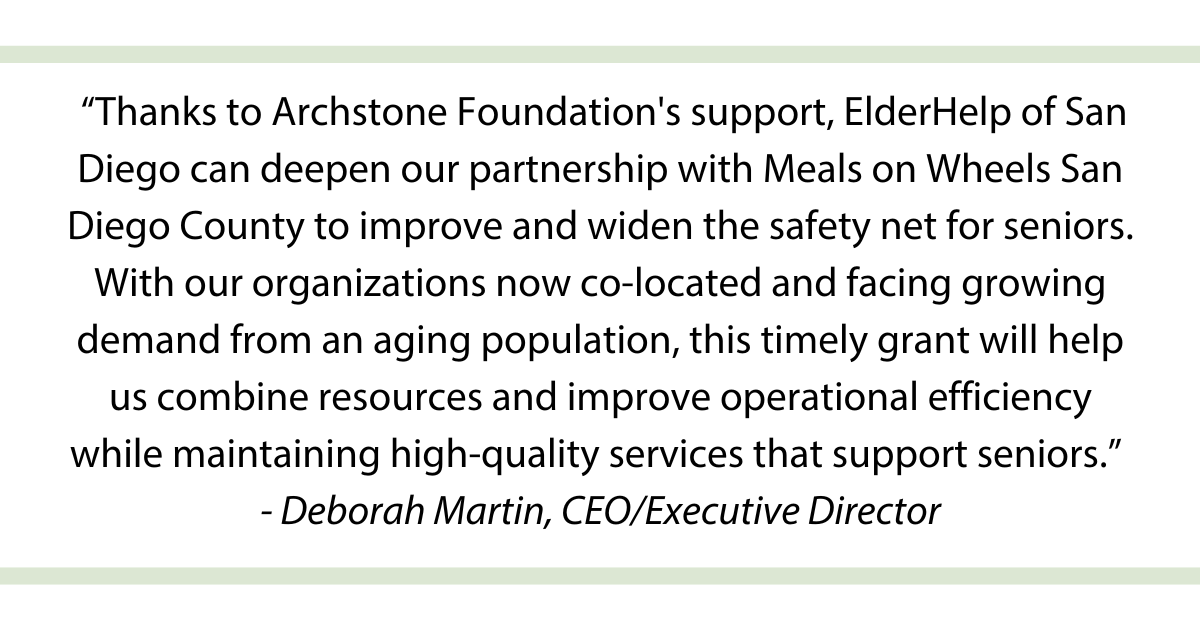
ElderHelp of San Diego recently moved its offices and pantry into the facilities of Meals on Wheels San Diego County, allowing both organizations to more effectively and efficiently support the health and wellness of older adults by reducing duplication of services and improving care coordination and referrals. ElderHelp will use its grant to engage a program and service integration specialist to implement synergies between the two organizations. By integrating whenever practical but also embracing unique programs, each organization can strengthen its range of services, develop workflows to coordinate care, and improve access to care.
Groceries for Seniors delivers healthy food for free to low-income older adults in San Francisco not served by food pantries. It will use its grant to implement a customer relationship management system that improves efficiency of operations, supports data-driven decisions, quickens community responses, and better demonstrates impact. All this will improve its ability to provide comprehensive care by sharing data and exploring opportunities for collaborating with CalAIM, the California Food is Medicine Coalition, the San Francisco-Marin Food Bank and the Department of Aging and Disability.
Institute on Aging in San Francisco offers a broad array of services and supports to help older people in the Bay Area live independently for as long as possible. It will use its grant to implement a new electronic health record system for its Companioa program, which serves dementia patients and their caregivers. The system will lay groundwork for integrating data among primary care physicians and others on patient care teams in compliance with the statewide Data Exchange Framework so patient records can be shared efficiently and securely with other health and social service providers. Additionally, the institute hopes to make Companioa a respite partner for participants in Medicare’s Guiding and Improved Dementia Experience (GUIDE) model.
Catchafire for Additional Support
This year’s capacity building program once again demonstrated an overwhelming need for infrastructure development and consultant support for nonprofits serving older Californians and their caregivers. To address this need beyond the limited number of grants we can provide, we continue to partner with Catchafire, offering all capacity building applicants and other California-based aging services organizations access to its services. Catchafire matches nonprofits in need of professional services with professionals willing to volunteer their expertise in such areas as marketing, web development, translation, and strategic planning. Organizations interested in benefitting from this expertise are urged to complete this form.
Gerson Galdamez, Jasmine Lacsamana, and Laura Rath contributed to this post.