Keenly aware of the power imbalance between grant-making and grant-seeking organizations, Archstone Foundation has once again asked the Center for Effective Philanthropy (CEP) to help us see how we’re doing on that front – and if we are on the right track toward centering justice and equity in our mission to improve the lives of older Californians and their caregivers.
Across the organization, we take these findings seriously and use them to hold ourselves accountable to the communities we aim to partner with and serve.
CEP, a nonprofit that helps funders improve their effectiveness, has surveyed more than 60,000 grantees in the past decade in order to help more than 350 foundations work more thoughtfully and collaboratively with those they fund to create a better and more just world. As you would expect, grantees usually give positive ratings of the organizations that fund them, so it’s critical to benchmark our new results against our past results and how other funders are viewed.
Last month CEP gave us its report after surveying representatives of 37 grantees (out of 54 invited to participate) and comparing their answers to those from all surveyed in the past – as well as 17 funders that closely resemble Archstone in scale and scope. Here are the most important results.
Justice, Equity, Diversity, and Inclusion
Our grantees recognize and share our commitment to justice, equity, diversity, and inclusion (JEDI) – demonstrated by the fact that 73 percent of respondents primarily serve historically disadvantaged groups. We ranked in the upper quartile among our peer group for clearly communicating what JEDI means for our work and demonstrating an explicit commitment to these core principles.
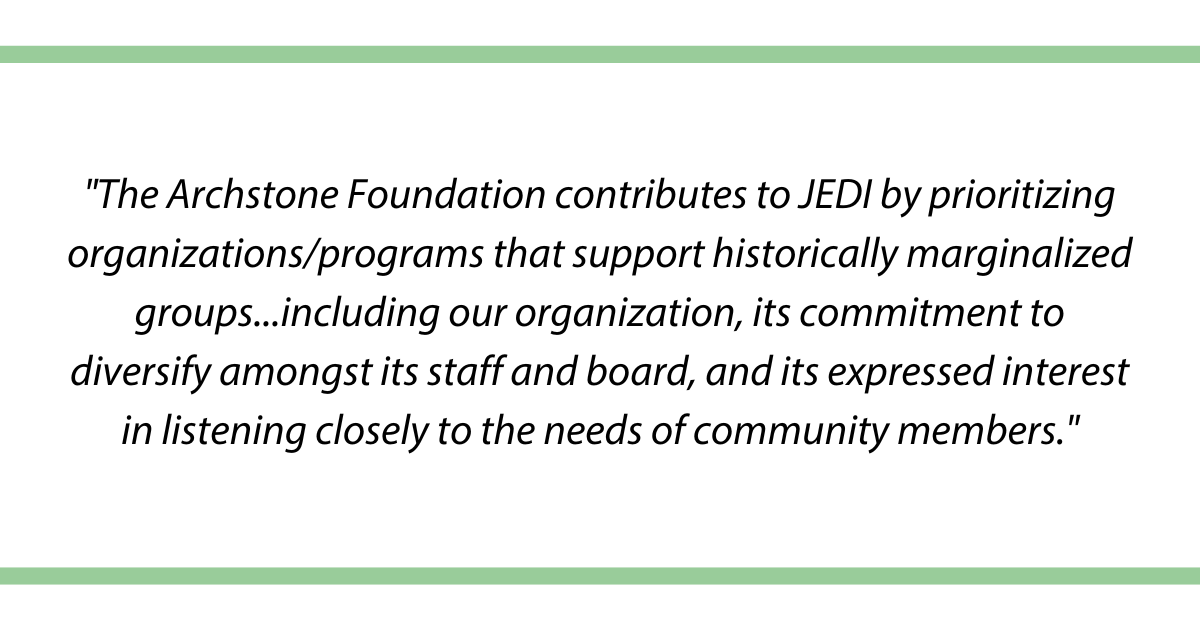
Integrating justice into our work is integral to our mission and vision of better care for older Californians – and we hope to continue clarifying how both our internal and external operations focus on equity in aging. Respondents recognized us for understanding the needs of the people and communities we serve (97th percentile compared to our peers), said we clearly communicate what JEDI means to our work (77th percentile), and see us as demonstrating an explicit commitment to those principles (80th percentile).
Relationship and Connections
Working in partnership with our community over the long term is a core value of ours. So we were happy that – as in our last survey, two years ago – we were in the 98th percentile for advancing the state of knowledge in the field.
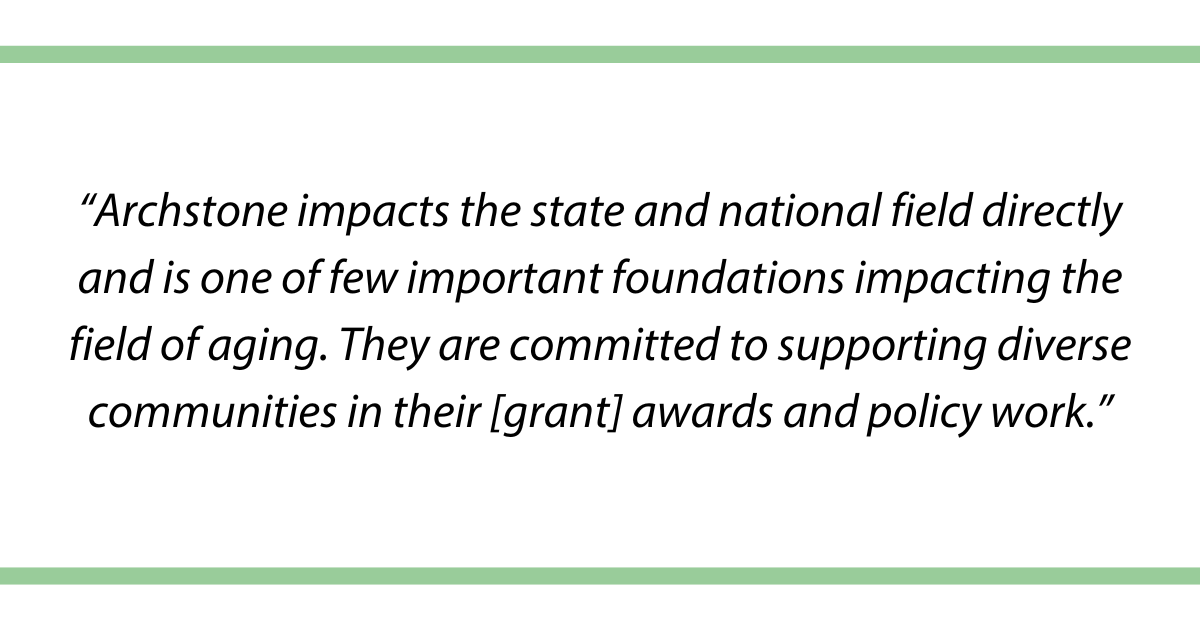
We think carefully about how we can best support our partners. So we are glad we were placed in the 97th percentile for understanding the social, cultural, or socioeconomic factors affecting our grantees’ work, the 99th percentile for understanding the fields in which they work, and in the 94th percentile for understanding their organizational strategies and goals.
Process Areas
Respondents said our processes have some good features but that we have opportunities to do better.
We are concerned that, as in the last survey, grantees feel pressured to modify their priorities if they want to submit successful grant proposals (80th percentile). We are working to decrease this pressure by providing greater clarity in our application process and continuing to work with closely with our partners to shape their applications prior to submission.

Still, grantees view us as clear and transparent about selection process requirements and timelines (85th percentile) as well as funding criteria (65th percentile), view our reporting process as straightforward (95th percentile), and say we have an adaptable reporting process (91st percentile).
Assistance Beyond the Grant
Beyond awarding grants, our staff seeks to use its training, skills, and connections to help grantees with more than money. The aim of this partnership approach is to create beneficial impact on grantees’ organizations as well as projects.
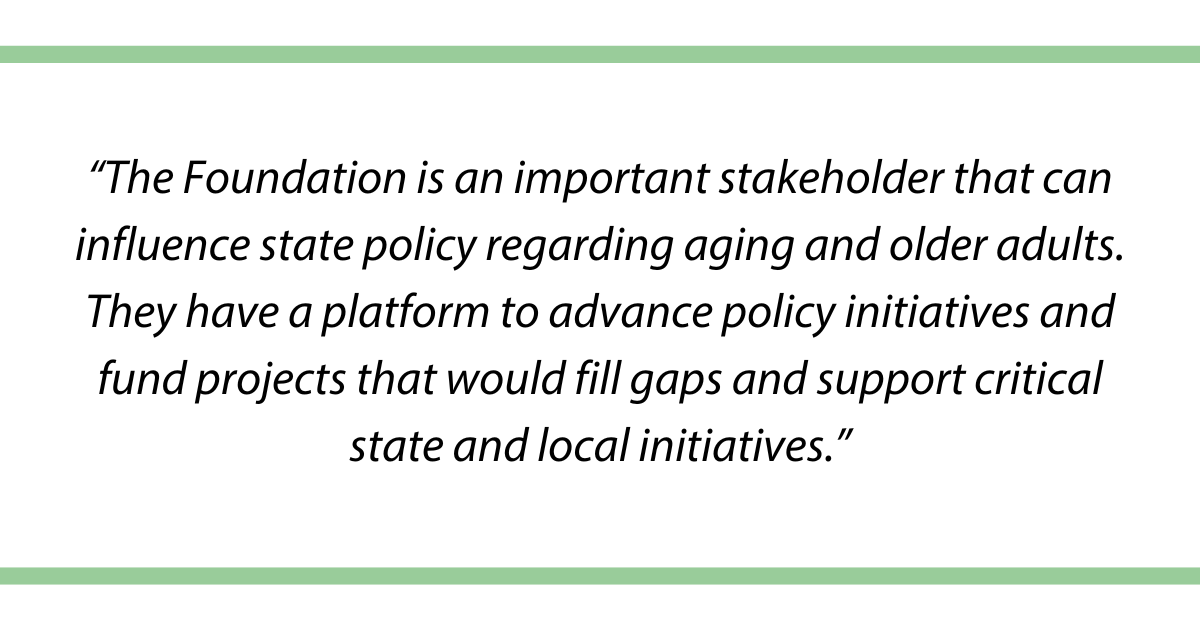
And 80 percent of grantees surveyed – a higher than average share – report receiving help from the Foundation including advice and guidance on program approaches, assessments, evaluations, communications, field building, fundraising, organizational capacity, and JEDI assistance or training.
Changes Based on the Results
Based on what these grantees told CEP, we are working to improve our processes and structure. We will continue to work to streamline our application process. Our most recent capacity building RFP, for example, shortened the initial letter of inquiry to become a document of no more than two pages that could be uploaded as an attachment on our grants portal. We know we can further improve our capacity building program by focusing our support on organizations providing direct services to older adults and by decreasing the burden of the application.
Within our integrated care strategy, we will also remain focused on making larger, multi-year grants that prioritize equity and integrating care at the systems level. These awards are the centerpiece of our equity-focused, coordinated care work and we understand that organizations need funding guaranteed over several years to achieve this kind of change.
Our Thanks
From all of us on the Board and staff at Archstone Foundation, thank you to those who took time to provide your candid thoughts about how we’re making progress and where we can do better. All are welcome to join them anytime by sending us your honest feedback, suggestions, and insights. And please stay tuned for our next survey two years from now.