
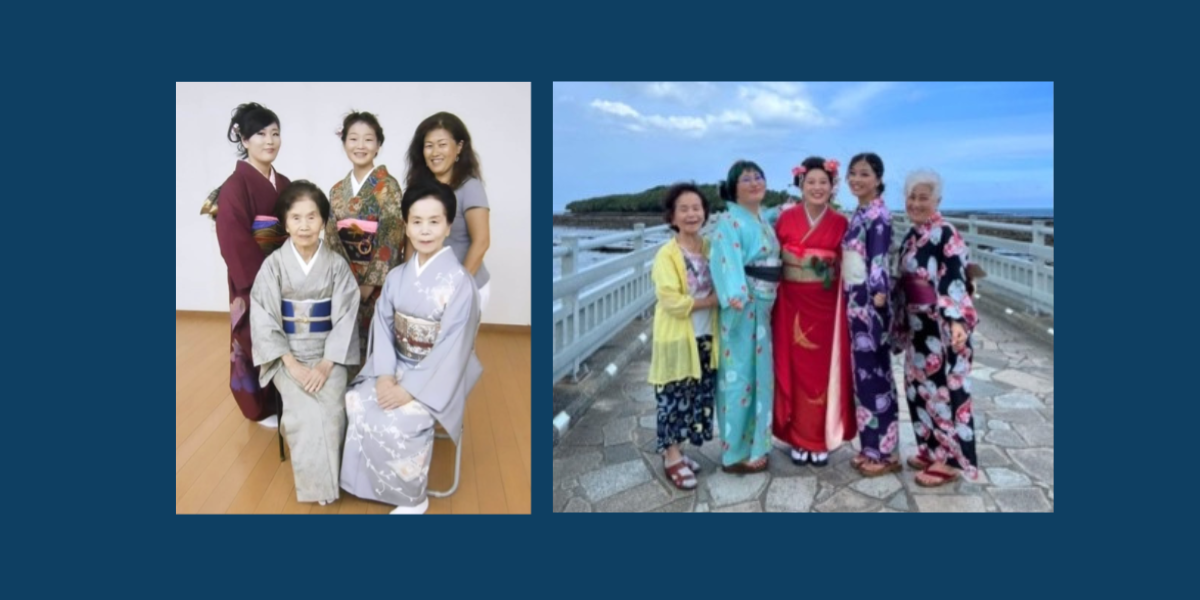
Seijin no Hi, Coming of Age. Photos courtesy of Sheena Uchino.
Left photo, top row, left to right: Stephanie Uchino (oldest sister), Sheena Uchino, Michiko Uchino (mother); bottom row, left to right: Tsuyu Ikei (maternal great grandma), Hiroko Kubo (maternal grandma).
Right photo, left to right: Hiroko Kubo, Stephanie Uchino, Sheena Uchino, Sarah Uchino, Michiko Uchino
As a current master’s student in public health, I had the opportunity to be a program intern at Archstone Foundation this past summer and fall. And, as my first exposure to philanthropy and the field of aging, I quickly learned the value of sharing my story to connect and positively influence older adults’ independence and dignity.
My first day in the office, I was greeted not only by the staff but by the entire Board of Directors. Participating in that Board meeting was an irreplaceable beginning of my internship; I learned so much about the organization and immediately felt welcomed.
Each member of the Foundation’s team has their own personal story about how they got to be at Archstone Foundation. As an organization, the staff leverages its power, position, and privilege to build trust, uplift the voices of organizations and community members, and amplify their grantmaking impact through storytelling and other communication efforts. They combine their experiences and expertise to strategically ensure that older adults have the right to age where they want, feel valued and heard, and have access to person-centered, coordinated care. Many staff members also volunteer, serve on boards, lead collaboratives, provide thought leadership, and in other ways do so much more than deliver grant dollars to grantees. All their time, efforts, and contributions underscore their passion and commitment in supporting the Foundation’s mission.
Through their mentorship and demonstration, the staff have taught me the value of working as a connector — someone who listens and brings together diverse perspectives in order to foster collaboration and give back to the community.
My Connection to Aging
My own experience, as both family member and family caregiver, has shaped my view and understanding of the disparities in our healthcare system — especially for older adults.
As a child of immigrants, I grew up without really knowing or having a close relationship with my grandparents. My dad’s mom had Alzheimer’s and passed away a couple of years ago before ever meeting her. And both my great grandpa and grandpa on my mom’s side passed away from cancer before I was born. All my relatives continue to live across the country in Japan. And so, my connection to and awareness of aging did not start early.
This past year, my great grandma on my mom’s side turned 101 and my maternal grandma, at 84 years old, continues to live with her dog Chiro, while cleaning houses and caring for others. It is important to recognize the ways in which aging looks different for everyone.
In 2020, when the gyms closed due to the pandemic, my dad, who had been swimming at the YMCA every morning for 20 years, started having tremors on his left side. Given his diabetes, high blood pressure, and high cholesterol, he was admitted to a hospital for bypass surgery to increase blood flow to his brain. With some permanent brain damage, he was diagnosed with a rare and progressive blood vessel disorder known as moyamoya disease.
After his discharge, I was my dad’s translator at speech therapy once a week and physical therapy twice a week. During this time, he was also laid off as a consequence of the pandemic, leaving my family with no health insurance.
My dad’s recovery was slow and challenging, making clear how our healthcare system is unable to protect and meet the needs of the population. In fact, my dad — at 60 years young — has now moved back to Japan because of his concern about the lack of culturally competent and affordable healthcare in America.
His situation was a turning point, sparking my interest in public health focused on care integration and addressing systematic barriers to access. I think it is important to share my dad’s story to incite change and highlight how the current healthcare system can be improved. It is sad to think his departure might have been avoided if the U.S. healthcare system was designed to focus on prevention rather than treating illness and disease. With better access and support earlier on, my dad might have been able to remain without fear of medical debt.
A Wide-Ranging Experience
While an intern, I had informational interviews with staff members, attended webinars and collaborative meetings, helped conduct site visits, reviewed applications for capacity building grants, and supported communication efforts.
I also worked to create a list of providers of Medi-Cal's new enhanced care management benefit — filterable by population of focus, managed care plan, and location — to help increase enrollment and streamline the referral process for community-based organizations, Area Agencies on Aging, providers, and others.
Another highlight was attending the CA For All Ages & Abilities: Day of Action. Hearing the speakers at the conference acutely highlighted the need for ongoing storytelling to generate necessary momentum and stakeholder buy-in for the state’s Master Plan for Aging.
Why it All Matters
Older adults — who are our grandparents, parents, family, and friends — have made and continue to make important contributions to society. Reflecting on my journey, I would not be who and where I am today without my parents’ support, help, and experiences with our health system. Aging is relevant to all of us, and we urgently need a system that values the lives of our parents, grandparents, and children, because they too will be a part of the aging community one day. Regardless of what the future holds for me; I hope to carry lessons learned from my internship – especially the ones about storytelling – into my career. Telling these stories helps to ground our work and support others to understand the need to make sure older adults and their caregivers continue to have access to the services and programs they rightfully deserve.
I want to thank the staff at Archstone Foundation who have made this experience so enriching and valuable. Thank you for your time, support, dedication, and willingness to teach and support me throughout the course of my internship.


