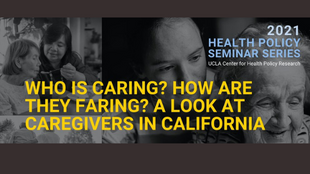
Understanding the scope of a challenge, starting with the demographics of the population of interest, is a critical first step in crafting solutions. In 2017, Archstone Foundation provided $510,000 to the UCLA Center for Health Policy Research in support of the California Health Interview Survey (CHIS). CHIS is largest state health survey in the nation, collecting information on health and health care across California. The Foundation supported a module of questions within CHIS to understand family caregivers, as questions on this important population have not been included in the survey for more than a decade.
Two leaders of the UCLA project team, Kathryn Kietzman, PhD, MSW, and Sean Tan, MPP, will detail their important findings from the caregiver study utilizing CHIS 2020 data during a webinar on Wednesday, December 1, 2021 at 1:00pm PT. (Click on the following for the press release and webinar registration.)
The researchers have created a rich, demographic profile of California caregivers, along with the characteristics of the people they are caring for. They have also compiled details about all the hidden costs of caregiving: The hours involved, the paucity of direct financial compensation, the missed opportunities for educational and career advancement, the shortchanging of caregivers’ own physical, social, and emotional needs. And their work identifies how a disproportionate share of all the financial, physical, and mental stress is falling on women, people of color, and low-income households.
The powerful evidence of the varied pressures on family caregivers, a backbone of the long-term care system, points to why the Foundation’s new strategic direction is focused on what we call the Three Ts: Teams, Training, and Technology.
Family caregivers gain confidence when they know they are providing the best care possible. This means empowering them to be fuller members of their loved ones' care team—allowing them access to electronic medical records, for example, so they can help make informed decisions about care. This also means providing the culturally relevant training and support required so caregivers can tackle evolving responsibilities and expectations. And it means making easy-to-use technological tools available whenever possible—to help caregivers with telehealth visits, online educational resources, or virtual adult day services programming to provide family caregivers an occasional respite.
An estimated 6.7 million people cared for a family or friend in California in 2020, and nearly one in four provided 20 hours of care a week to someone with a serious or chronic illness or disability. These are significant numbers and knowing who caregivers are—and what fiscal, physical, and psychological strains they confront—can help fuel better policies and a better allocation of resources.
Read the policy brief and view the accompanying infographic or visit the UCLA Center for Health Policy Research website.
Understanding the scope of a challenge, starting with the demographics of the population of interest, is a critical first step in crafting solutions. In 2017, Archstone Foundation provided $510,000 to the UCLA Center for Health Policy Research in support of the California Health Interview Survey (CHIS). CHIS is largest state health survey in the nation, collecting information on health and health care across California. The Foundation supported a module of questions within CHIS to understand family caregivers, as questions on this important population have not been included in the survey for more than a decade.
Two leaders of the UCLA project team, Kathryn Kietzman, PhD, MSW, and Sean Tan, MPP, will detail their important findings from the caregiver study utilizing CHIS 2020 data during a webinar on Wednesday, December 1, 2021 at 1:00pm PT. (Click on the following for the press release and webinar registration.)
The researchers have created a rich, demographic profile of California caregivers, along with the characteristics of the people they are caring for. They have also compiled details about all the hidden costs of caregiving: The hours involved, the paucity of direct financial compensation, the missed opportunities for educational and career advancement, the shortchanging of caregivers’ own physical, social, and emotional needs. And their work identifies how a disproportionate share of all the financial, physical, and mental stress is falling on women, people of color, and low-income households.
The powerful evidence of the varied pressures on family caregivers, a backbone of the long-term care system, points to why the Foundation’s new strategic direction is focused on what we call the Three Ts: Teams, Training, and Technology.
Family caregivers gain confidence when they know they are providing the best care possible. This means empowering them to be fuller members of their loved ones' care team—allowing them access to electronic medical records, for example, so they can help make informed decisions about care. This also means providing the culturally relevant training and support required so caregivers can tackle evolving responsibilities and expectations. And it means making easy-to-use technological tools available whenever possible—to help caregivers with telehealth visits, online educational resources, or virtual adult day services programming to provide family caregivers an occasional respite.
An estimated 6.7 million people cared for a family or friend in California in 2020, and nearly one in four provided 20 hours of care a week to someone with a serious or chronic illness or disability. These are significant numbers and knowing who caregivers are—and what fiscal, physical, and psychological strains they confront—can help fuel better policies and a better allocation of resources.
Read the policy brief and view the accompanying infographic or visit the UCLA Center for Health Policy Research website.