As the Foundation moves forward with our new grantmaking strategy, we are launching a new blog series that highlights how our grantee partners are bringing this work to life in communities across California. Through their voices, we will explore what it looks like to catalyze equitable change in health and social care systems and hear directly from older adults about the impact these efforts are having on their lives.
“I am grateful for the opportunity that [SCSEP] gave me. I would like others, especially fellow retirees, or those transitioning to careers, to know that it's never too late to learn something new, contribute to your community, and regain a sense of purpose.” - Marion G., NAPCA SCSEP Enrollee (Los Angeles, CA)
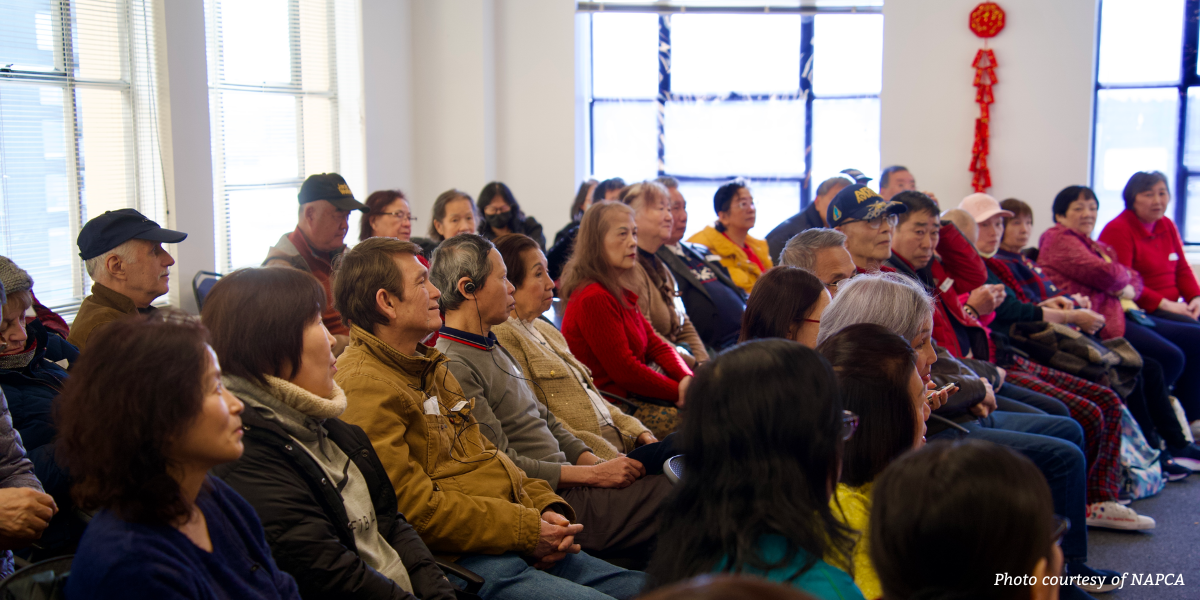
When the National Asian Pacific Center on Aging (NAPCA) began running its Senior Community Service Employment Program (SCSEP) in 1989, we didn’t expect it to transform into a lifeline for older adults across the Los Angeles, Seattle, and Chicago metropolitan areas. SCSEP is the nation’s only federally funded employment training program for older adults looking to reenter the workforce.
What we viewed as an unshakable, cornerstone resource for older adults changed last year when funding for SCSEP was abruptly paused without explanation or a timeline for action. In other words, the entire program shuddered to a halt.
Mobilization Through Collective Storytelling
When we learned that our SCSEP enrollees were no longer going to receive the assistance they had been promised, we were at a loss. Our community partners faced the same reality with no clear path forward. As the funding deadline came and went, it became obvious that we had to escalate the issue.
But could we get others to care? Admittedly, SCSEP is a smaller federal program. In an age of data analytics, AI-driven outputs, and statistical information overload, we often forget that human lives are behind the data sets that dictate policies. It may raise eyebrows to say that approximately 1 in 3 older adults 65+ have incomes 200% below the federal poverty line, but each data point is a real person.
We knew our “data points” were the older adults who relied on SCSEP. It was John, who told us he could no longer afford his medications, and Bonnie, who worried about having enough groceries to last the month. It was the many older adults who never made it to us after the pause began – those whose phone lines became disconnected because they had no money for bills, and whose digital literacy training halted before they could learn to navigate online maps. When those stories are right in front of you, the problem becomes impossible to ignore. That’s the power of storytelling. It turns data into human reality.
At NAPCA, we’re uniquely situated to serve older adults across languages, cultural backgrounds, and geographical locations. While this makes for a vibrant collection of stories, the ways we capture and share these testimonials vary.
As an organization keen on tackling language barriers, we encouraged our older adults to share their stories in languages that felt most genuine to them, wanting to capture raw, authentic experiences over careful, clipped responses. Through this process, we learned there was no golden ticket method for gathering stories. Some people preferred speaking to us over the phone, while others typed out their narratives on Word documents. Some mailed in handwritten accounts because they didn’t have the technology skills needed to type a letter. Sharing these stories was no different. Our older adults’ words found homes in ethnic newspapers as well as the inboxes of our e-newsletter subscribers. Meeting people where they were to get their stories also meant ensuring they could hear their stories – and others like them – through the same channels they were familiar with.
The Role of Elder Advocates and Coalition Building
In a political landscape where every topic crossing our representatives’ desks seems to be an emergency, time is attention and attention is power. As part of a national aging coalition, NAPCA joined other community partners to take these stories to Congress, advocating for the resumption of SCSEP and other services affecting our elderly populations. One nonprofit carrying a handful of participant quotes might be negligible, but a coalition of organizations armed with stories of hardship and resilience is unavoidable. The more Congressional offices we met with – across the chambers of Congress and the political spectrum – the more powerful our elders’ stories became.
Through our collaborative efforts, SCSEP funding resumed after four long months. Though the ultimate outcome was fantastic news for the people we serve, the consequences of this pause were grave, and I can’t help but wonder – could this have been resolved sooner?
What NAPCA did was not new. Storytelling has been a part of American history and nonprofit organization advocacy for generations. But when the world became a numbers game, many of us seemed to forget that real human experiences are what founded our organizations. As a community, it’s imperative that we’re proactive in capturing stories as they’re happening – the good, the bad, the in-between – and then boosting those stories on channels our stakeholders use to expand our reach. This means relying on traditional communications systems like snail mail and print media but also maintaining strong listservs and staying current on developing social media platforms.
As organizations dedicated to serving aging populations, the onus is on us to empower older adults to share these stories, giving them the compassion and dignity they deserve. But we don’t have to do it alone. Coalitions exist as mediums of support when times get tough and bandwidths are low. Find organizations with similar missions as yours and when adversity strikes, lean in together. The more stories we share as a collective, the greater the impact our organizations – and older adults – have on the national landscape.
About NAPCA
The National Asian Pacific Center on Aging (NAPCA) is a non-profit organization devoted to improving the quality of life for Asian American, Native Hawaiians, and Pacific Islander (AANHPI) older adults through advocacy and access to resources essential to their well-being and independence, regardless of language or culture. Learn more about the organization at www.napca.org.