Heather Brungardt with Partners in Care Foundation also contributed to this post.
Community health workers (CHW) occupy an increasingly important but often underappreciated position in today’s health care system. And efforts to get more people ready to occupy these CHW jobs aligns smartly with Archstone Foundation’s new strategic priorities, the Three Ts: Teams, Training and Technology.
That is why the Foundation is pleased to support a new training program so that more CHW’s can become part of care teams across California – addressing the current healthcare workforce shortage and building capacity for an integrated health and social service system for chronically ill and frail older adults.
The program, a collaboration of Partners in Care Foundation (Partners) and Los Angeles Valley College (LAVC), launched its first free 48-hour Community Health Worker pilot workshop in January. A second workshop will begin March 22nd. The workshops are part of a larger Partners effort to develop a self-directed noncredit, online two-course workforce program with the college.
The CHW Training Model
Partners is leveraging the expertise of an interdisciplinary, multisector project advisory council, the Center for Health and Social Integration at Rush University, its own training experience, and LAVC’s workforce development expertise, to train and increase the employment of CHW in community-based organizations, physician offices, and other healthcare settings.
The pilot workshops include four modules: Introduction to the Community Health Worker Role, Building Foundational Skills in Helping, Community Health Worker Best Practices, and Understanding the Health and Social Care Needs of Older Adults and their Caregivers. They are designed to provide a foundation for continued on-the-job learning. Participants work at their own pace on the Canvas online platform and may access instructors for questions and to guide their learning. Students answer surveys before and after each course, providing data used to inform the curriculum.
Response to the pilot has been strong: 110 people have registered and 33 are actively working on the first workshop, with an additional 50 students planned for March. To meet demand, Partners and LAVC are considering a second March workshop.
LAVC views the training as a potential entry point to other career pathways, including nursing and respiratory therapy offered by LAVC and other potential health science programs offered within the Los Angeles Community College District. This approach is especially attractive to those with a particular interest in health care who are looking to enter or return to the workforce quickly.
Following the pilot workshops, the CHW training will be institutionalized by mandated enrollment levels and fueled by an ethos of getting people trained and into jobs. If the targeted enrollment of 30 is achieved, the training can be offered every spring and fall.
What Are Community Health Workers (CHWs)
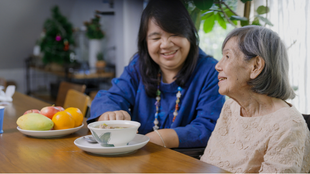
CHWs are frontline public health workers who provide an important link between health care, social services, and the community. They help chronically ill older adults, and others, find and access medical and behavioral health services. They also serve as a liaison between providers and patients, help navigate the health insurance system, and connect patients with social services including housing, food, Supplemental Security Income, utility bill relief programs, and transportation.
CHW Value to Health Care
Recent research validates the importance of CHWs, their unique skill set for filling critical service delivery gaps, and their ability to serve as extenders for a health care team. There is also growing demand for CHWs trained to work with older patients. CHWs come at a lower cost and offer a demonstrable return on investment. They also have a more trusted relationship with the communities where they live and serve, as well as with medically complex patients receiving services.
CHWs are increasingly being used by medical practices, insurance plans, and community-based organizations, with their roles varying based on the setting or focus of the organization they serve. With healthcare, there is an increased interest in mitigating adverse social conditions, including lack of stable housing, unreliable transportation, and food insecurity, which lead to inequitable health outcomes. Accordingly, CHWs are often focused on screening patients, social needs, and providing resource assistance.
CHWs make home visits, phone calls, or connect online to deepen their awareness of issues influencing patients’ ability and interest in following their medical care plans. They also provide education and information on managing health conditions and navigating health care systems. The value of CHWs is also recognized by low-income housing providers who are using U.S. Department of Housing and Urban Development funding for “residential service coordinators.” Housing providers are beginning to explore the benefits of adding CHWs as staff.
Connecting to Archstone Foundation’s New Strategic Plan
With its Training priority area, the Foundation centers its grantmaking on training health care and social service providers, professionals, and paraprofessionals on effective, evidence-based team care models, with a focus on improving teamwork and enhancing the expertise and skills needed to provide quality care for older adults. The Partners and LAVC CHW workforce training program helps to ensure that newer team members, such as CHWs and promotores de salud (the Spanish term for CHWs), who are taking on more care coordination and navigation responsibilities to fill gaps in traditional care, receive appropriate training for those new roles and responsibilities.
Training can help develop the capacity of team members to address issues of race, class, gender, and sexual orientation, an essential component of providing care that meets older adults’ needs holistically and links to the Foundation’s Seven Cs. Training grants may also draw on our emerging learning in models of team care to support the translation of that knowledge into training programs for current practitioners in health care and social services to provide better care.
This work is in keeping with the Foundation’s mission, to improve the health and well-being of older Californians and their caregivers.
How To Register
Interested persons, including students, older adults, or those seeking a second career or entrance into the fields of health and social needs are encouraged to use Partners’ webpage to learn more about the project and register.