Navigating health and social services becomes more challenging as we age. And our system often fails to support the health, vitality, and well-being of older adults in California. With a bold idea about how to better understand the drivers of older adult health, Archstone Foundation partnered with RAND, a nonprofit global policy think tank, to develop what we call an action framework.
The interactive online framework, launched this month, provides a detailed picture of the current health and well-being of the state’s older population – including data and trends over time – to help point the way toward transformational progress. It highlights specific actions that funders, policymakers, and advocates can take to help achieve equitable, coordinated care for older adults and their caregivers.
Framing a Better Future
Using publicly available qualitative and quantitative data to identify opportunities for improvement, the framework illustrates how achieving different goals could lead to a better future. Notably, it shows where accelerated action could help close gaps in health disparities among people of different races, ethnicities, genders, incomes, and locations.
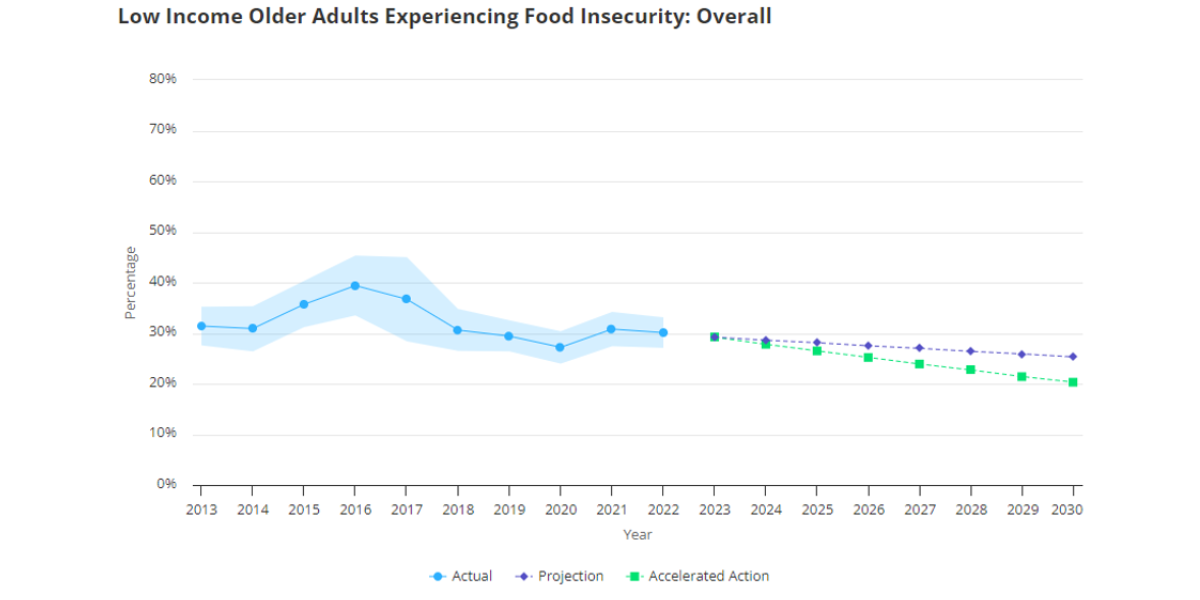
For example, we examined connections between health with social services. Measures include the number of low-income older Californians experiencing food insecurity – nearly 770,000 in 2022, the equivalent of half the population of San Diego. Without action, by the end of the decade one quarter of the state’s older people (dark blue line below) will be food insecure, meaning they won’t have regular access to enough safe and nutritious food to lead an active and healthy life.
We use the framework to show how transformative change – via the green accelerated action line – could lead to 20 percent improvement. In this case, accelerated action would result in about 130,000 fewer people becoming food secure by 2030.
Closing Gaps in Disparities
The framework shows changes in the health outcomes of communities that have faced unfair and unjust treatment and allows users to visualize evolving disparities based on race, ethnicity, language, socioeconomic status, and geographic location.
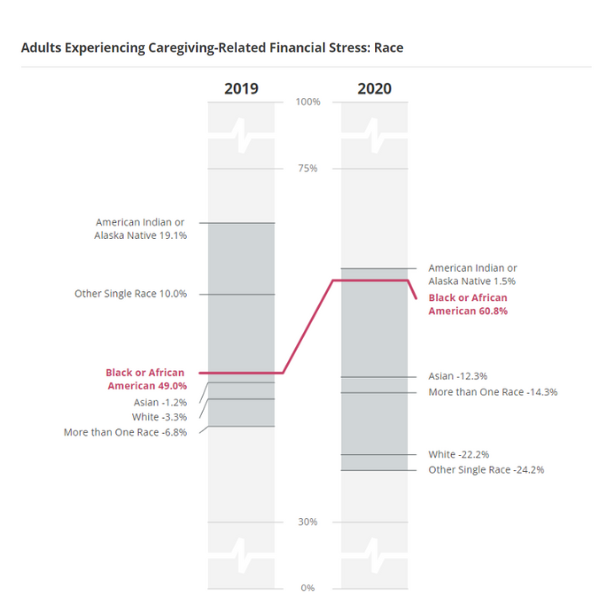
For example, 49 percent of Black caregivers in 2019 experienced financial stress as a result of their caregiving, which was just 3.3 percentage points higher than White caregivers. But the next year, during the COVID pandemic, the percentage of Black caregivers experiencing caregiving-related financial stress jumped to 60.8 percent, while caregiving-related financial stress among White caregivers decreased, widening the gap between Black and White caregivers to 22 percentage points. Observing the increase in disparities helps focus attention on ensuring that efforts to reduce caregiver financial stress take into account the unique needs of Black caregivers.
Ways that You Can Get Involved and Help
Each section of the framework concludes with a Call to Action for funders, policymakers, and advocates. To address disparities in caregiver financial stress, for example, it urges advocates to highlight the different barriers faced by caregivers of different racial backgrounds and encourages them to identify ways to lower those barriers, including by backing policies that would provide caregivers respite. Policymakers can develop those policies and ensure the government collects data by population characteristics. And funders can support programs to alleviate caregiving burdens, particularly for those at greater risk of poor health and well-being as a consequence of their caregiving.
Your Turn
There are several approaches to exploring the data and calls to action:
- Click “Explore the Framework” at the top of the landing page to navigate to specific content, data and trends.
- If you are looking for a specific measure, check out the “Frequently Asked Questions” in the upper right corner, and scroll to the table of measures. Use the hyperlinks to see where that information is located.
- You can also review the Action Framework in its entirety by reading through and clicking “up next” at the bottom of each page.
Important Input Along the Way
We tested and refined the framework over several months, a process that included gathering feedback from a diverse range of audiences:
- Ready to Launch Research conducted in-depth interviews with two funders, four advocates, and three policymakers. When asked how likely they would be to use the framework in their work, the average score was 8.5 on a 10-point scale.
- We shared prototypes and data points with our partners at the California Department of Aging and found the framework is synergistic and complementary to its Master Plan for Aging data dashboard.
- We presented the framework concept and sample data visualizations at the June Grantmakers in Health Annual Conference in Portland, Oregon. The audience was enthusiastic about its possibilities.
- Seven experts provided regular feedback on the framework’s development:
- Alexander Fajardo, MCP, CFC, executive director of the El Sol Neighborhood Educational Center
- Lisa Gibbs, MD, chief of Geriatric Medicine and Gerontology and the Ronald Reagan Endowed Chair of Geriatric Medicine at University of California Irvine
- Sei Lee, MD MAS, professor of Geriatrics at the University of California San Franciso and senior scholar for the San Francisco VA Quality Scholars fellowship
- David Lown, MD
- Didier Trinh, director of policy and advocacy at the Diverse Elders Coalition
- Neil Wenger, MD, MPH, professor of General Internal Medicine and Health Services Research at the University of California Los Angeles and a RAND adjunct senior scientist
- Phyllis Willis, DSW, director of Aging Programs South Division at Watts Labor Community Action Committee
What’s Next
Using the framework, we will continue working closely with our partners to encourage efforts that achieve justice and equity for historically underserved and marginalized groups. For monitoring future change, the Master Plan for Aging Data Dashboard provides valuable insights over time including interactive maps and graphics for equity-related scores, geographic data, potential drivers of key issues, and opportunities to stay engaged in your community.
The framework is an exciting step forward on a journey we hope you will take with us.