
It’s Fall Prevention Awareness Week in California, an annual event created in 2008 as a result of Archstone Foundation’s advocacy efforts. So it seems like a fitting time to reflect on the Foundation’s two decades of investment, partnership, and commitment to build the field of fall prevention to improve the lives of older adults in California and the nation.
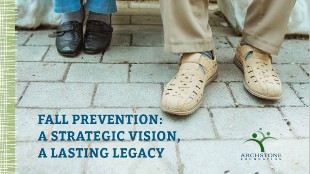
The Foundation’s latest legacy report, titled Fall Prevention: A Strategic Vision, A Lasting Legacy, provides a detailed, retrospective review of the groundbreaking work our grantees did. But the report is not simply about looking back.
It also sounds a clarion call to build on this important work and move forward.
As you read the report, and we certainly hope that you will, please consider ways that you and your organization can pick up the baton and help advance efforts to prevent falls, which remain the leading cause of injury—and death from injury—among adults over 65 in California and across the United States.
Building a Field
The Foundation’s work in fall prevention dates back to 1996, a time when there was little understanding among the health care community or the public that falls were in fact preventable, and even less knowledge about the financial impact they had on the health care system.
Archstone Foundation saw the need to build the field of fall prevention into a critical public health issue and, over the next two decades, developed a strategic long-term vision to make it happen.
Starting with grantmaking and coalition-building at the local level in California communities, the Foundation, with the launch of its Fall Prevention Initiative in 2005, helped build a vibrant statewide network. The hub and coordinating center for the network was the Foundation-funded Fall Prevention Center of Excellence (FPCE), housed at the University of Southern California (USC) Davis School of Gerontology. While building the California fall prevention model, the Foundation also began funding the National Council on Aging (NCOA) to address falls at the national level. With Archstone Foundation support, NCOA developed and implemented a National Action Plan. Today, key provisions of that plan are embedded into federal law.
All told, between 1996 and 2015, Archstone Foundation invested $12.69 million through a total of 63 grants to build the field of fall prevention and set it on a course to sustainability.
The 12 Key Strategies for Success
Perhaps the most gratifying thing about the Fall Prevention Initiative is how much of the work is still going strong years after the Foundation’s funding in fall prevention ended. One of the reasons why that has happened can be attributed to the 12 Key Strategies for Success the Foundation employed to build the field of fall prevention, support its grantees, and maximize and sustain the impact of its investments:
- Providing Direct Service to Clients/Families.
- Convening Stakeholders.
- Facilitating Funder Collaboration.
- Creating Cross-Sector Partnerships.
- Workforce Development (Professional Education and Training).
- Grantee Convening, Technical Assistance, and Research Support.
- Building Grantee Capacity.
- Policy and Advocacy.
- Building the Science (Research and Data Development).
- Raising Awareness – Public Education.
- Dissemination Strategies.
- Promoting Sustainability.
Significantly, the 12 Key Strategies for Success developed for fall prevention continue to guide the Foundation’s grantmaking in other areas. The strategies serve as a useful template for philanthropic field-building efforts, one that other foundations and organizations can adopt and adapt as they catalyze positive change around other critically important issues.
Forging a Lasting Legacy
Examples abound of the fall prevention work that is still going strong. Although funding for the USC Davis School of Gerontology’s Fall Prevention Center of Excellence (FPCE) has ended, the FPCE’s website, stopfalls.org, continues to provide a comprehensive set of resources to older adults, their families, caregivers, medical professionals, and researchers interested in fall prevention.
In addition, the FPCE continues to serve as an information hub for regional California fall prevention coalitions and the statewide StopFalls California coalition, which currently has 93 members—including 15 community fall prevention coalitions, as well as health, aging, and senior injury prevention providers. Seven of the 15 coalitions participating are from the original 10 coalitions funded by Archstone Foundation.
Across the nation, more than 30 statewide Falls Free coalitions still operate, addressing the needs of older adults at risk of falls through information, training, and evidence-based programs.
In addition to California’s Fall Prevention Awareness Week, fall prevention awareness events are held across the nation each year in September. In 2018, 43 states and the District of Columbia recognized national Fall Prevention Awareness Day, collectively reaching nearly 154.7 million individuals through national, state, and local press releases, Twitter, Facebook, and more.
There is, of course, much more work that needs to be done. We hope that you will help to cultivate the seeds that Archstone Foundation has planted over its two decades in fall prevention. If you’re interested in learning more or want to see how you can help advance the field of fall prevention, please read the full report, Fall Prevention: A Strategic Vision, A Lasting Legacy.



Comments
This is a wonderful legacy, indeed. I like the stopfalls.org website; it has practical info that I use in my practice and refer patients/families to it as well.