
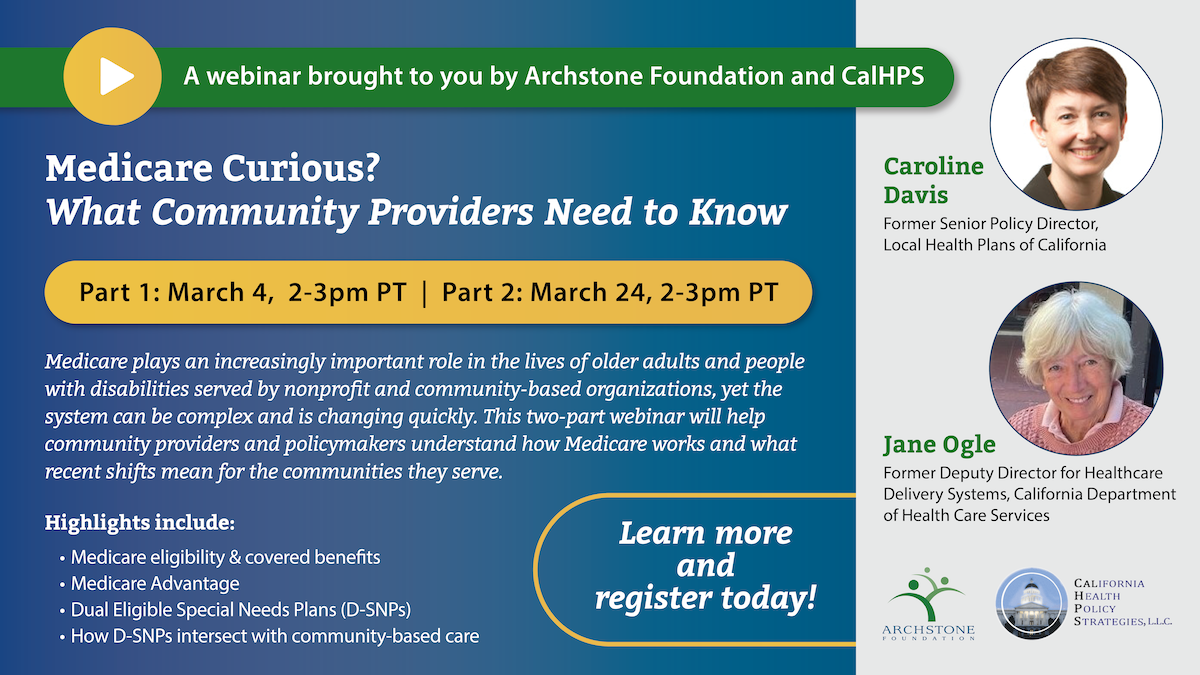
Medicare plays an increasingly important role in the lives of older adults and people with disabilities served by nonprofit and community-based organizations, yet the system can be complex and is changing quickly. This two-part webinar from Archstone Foundation and California Health Policy Strategies will help community providers and policymakers understand how Medicare works and what recent shifts mean for the communities they serve.
In part one, Caroline Davis, former Senior Policy Director, Local Health Plans of California, and Jane Ogle, former Deputy Director for Healthcare Delivery Systems, California Department of Health Care Services, will give an overview of Medicare, including the history of the program, eligibility, covered benefits, and financing, with real-world examples drawn from community settings. They will also provide information about Medicare's managed care delivery system, known as Medicare Advantage through which nearly half of California's older adults receive their Medicare benefits.
Within Medicare Advantage, Dual Eligible Special Needs Plans (D-SNPs) are expanding rapidly across the state as more people who are dually eligible for Medicare and Medi-Cal are encouraged to enroll. What does this mean for community-based service providers, policymakers, care coordinators, advocates, and caregivers?
The second webinar in the series will provide an overview of D-SNPs and offer practical insights to help nonprofit organizations better support dual-eligible individuals, understand how D-SNPs affect referrals and care coordination, and navigate how D-SNPs intersect with community-based care.
Part 1: Access the slides here.
Watch the recording here.
Part 2: Access the slides here.
Watch the recording here.

