
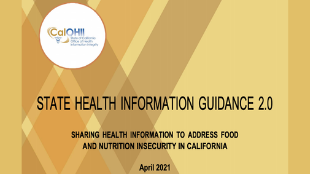
The California Office of Health Information Integrity (CalOHII), in collaboration with Nourish California and the Primary Care Association, has published the State Health Information Guidance Volume 2 to address food and nutrition insecurity among Californians. The SHIG 2.0 shows a new path forward for sharing data among food and health care providers, and in interpreting state and federal laws.
Funded by Archstone Foundation, the California Health Care Foundation, Centers for Medicare and Medicaid Services (CMS), CommonSpirit Health, and Nourish California, the SHIG 2.0 shares the state of California’s authoritative, nonbinding guidance on when, where, and why patient information can and should be exchanged between health care providers and providers of nutrition and food services, such as medically tailored meals service providers, food banks, and Older Americans Act nutrition programs (e.g. Meals on Wheels), to name a few. SHIG 2.0, which was published in April, also serves as an important tool for clarifying the confusion around privacy rules that govern health information sharing in California in non-legal and non-technical language.
Archstone Foundation is proud to support CalOHII, Nourish California, and the SHIG 2.0 Guidance, which represents an important step forward in integrating social care into the delivery of health care to improve the health and wellbeing of older adults and their caregivers.
About CalOHII
CalOHII has responsibility for the statewide leadership, coordination, policy formulation, direction, and oversight of the implementation and compliance of the Health Insurance Portability and Accountability Act (HIPAA) by state departments. Specifically, CalOHII evaluates, monitors, and reports on state department compliance; monitors, develops, and revises HIPAA compliance policies; conducts periodic assessments of state entities to determine which state departments must be HIPAA compliant; and provides overall leadership and guidance to state departments on HIPAA and other related state and federal laws.
Why Food Insecurity and Why California?
Food insecurity and its impact on adults 65 and older is not new news. The lack of enough affordable, nutritious food to live a healthy active lifestyle has doubled since the turn of the century, and we know that food insecure older adults are more likely to be in fair or poor health and have frequent comorbidities, such as diabetes, depression, hypertension, and heart disease, among others. We also know that SNAP (Supplemental Nutrition Assistance Program) participation is associated with medication adherence among food-insecure older adults.
Moreover, there is evidence suggesting that programs supporting food insecurity can improve health outcomes and the likelihood of aging in place. Nevertheless, according to the California Association of Food Banks, one in every four Californians, or 10 million individuals, do not know where their next meal will come from. Ten million is the entire population of Los Angeles County — imagine the entire population of LA County not knowing where their next meal will come from!
The SHIG 2.0 Responds to a Clarion Call
The 2019 National Academies of Sciences report, “Integrating Social Care into the Delivery of Health Care” proposes that to strengthen social care in the delivery of health care, new approaches to system design, staffing, information and technology, financing, and research are needed. In addition, they identified goals to support the integration, improve health, and to reduce health disparities. One such goal is to develop a digital infrastructure that is interoperable between health care and social care organizations so that organizations that provide social services, as well as consumers who use them, can interact with each other, and with the health care system.
The State of California created the non-binding State Health Information Guidance (SHIG) Volume 2 to help standardize and clarify federal and state law. In SHIG Volume 2, the State of California provides guidance about how health and social services information can be shared in the day-to-day practice of providing integrated care and services to address food and nutrition insecurity. This is a great initial step in paving the way for a digital infrastructure.
Complex data privacy laws complicate seamless coordination of care across the various social service and health providers who need to work together to address food insecurity. Both providers may be reluctant to share information because of the confusion and complexity around these laws. And in some cases, service providers may be reluctant to share data, or they must create complicated agreements between providers — especially when a patient/client’s care occurs outside of a clinic or medical office, which occurs when addressing food insecurity.
The SHIG 2.0 clarifies existing federal and state laws that affect disclosure and sharing of health and social services information. In addition, it provides scenario-based guidance written in simple, everyday business language garnered through the development process, which involved extensive input from non-profit, private, community-based, and government organizations involved in the delivery of health care, eligibility, enrollment, and food assistance services.
The Role of the SHIG and Next Steps
The SHIG is not intended to be a comprehensive solution for all the associated legal, technological, operational, cultural, and financial issues associated with sharing health and social services information. Rather, it is intended to encourage responsible and appropriate information sharing in California, and to promote an important dialogue among health and social services providers and stakeholders regarding what can be done within the current federal and state laws.
Health providers, patient advocates, providers of nutrition and food assistance, CalFresh, enrollment and program services, health plans and other payers, county and local governments, and state agencies, among others, must collaborate and talk with one another to fully achieve the SHIG’s purpose and to improve the health and well-being of older Californians. The dialogue must continue well beyond the SHIG 2.0!The state also encourages SHIG readers to take appropriate next steps for their organizations to improve coordination of services to address food and nutrition insecurity. Possible next steps might include:
- Sharing the SHIG with appropriate staff and leaders within your organizations and in partner organizations.
- Reviewing and updating organizational policies and procedures.
- Identifying legislative changes that protect patient privacy, while limiting obstacles for patient-centric integrated care and addressing food and nutrition insecurity as a coordinated service.
To learn more about the SHIG, read the previous Point of View blog post, Supporting the Exchange of Health Information to Benefit Older Adults. And stay tuned for upcoming webinars!


Comments
Thank you for sharing this important data with the community! We are looking at a new age of understanding and service for our food-poor neighbors and friends. Thank you Archstone Foundation and Jolene Fassbinder for your great contributions.
this is terrific! the specificity and scenarios make it a practical tool and I look forward to sharing it with colleagues. Makes me think we could do something similar for sharing information when it comes to elder abuse issues. It’s often difficult for elder abuse forensic centers/MDTs to pry medical information from health care providers, and there are lingering questions regarding sharing information among agencies as well.
Dr. Mosqueda,
Agreed, its a great practical tool and an important first step in data sharing!
Thank you for sharing it with your colleagues.