
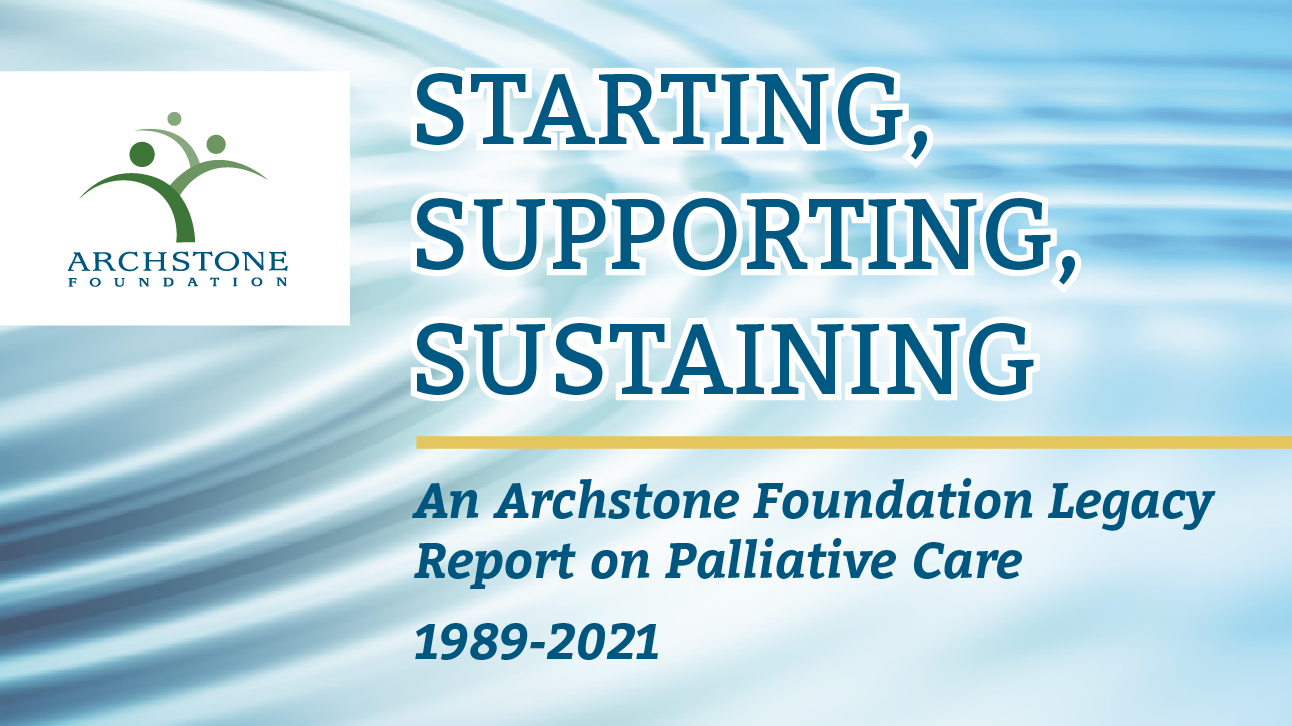
We are excited to launch a new series on Point of View – Looking Back, Looking Forward: Our Legacy in Improving End-of-Life and Serious Illness Care.
During the past three decades, Archstone Foundation has made more than 130 grants for more than $16 million in palliative and end-of-life care. Having launched a new strategic plan in 2021, with a focus on connecting health care to social services in a more thoughtful and comprehensive way, it’s time to reflect on this work and its connection to our strategic plan to improve the health and well-being of older Californians and their caregivers.
To begin our look back, we partnered with the excellent consultant team of Kate O'Malley, Kathleen Kerr, and Monique Parrish. They spent a year reviewing each end of life and palliative care grant, interviewing both leaders in the field and grant recipients, then assessing the body work – including where there is more to be done.
The team took a highly thoughtful and innovative approach. Recognizing there is no single measure for assessing the impact of our diverse portfolio of projects – and understanding impact is best assessed by looking at how hundreds of outputs address the needs of individuals and organizations delivering care – they coded each grant for seven distinct outputs. Then they organized their report by those outputs – bringing the document to life by weaving in case studies, quotes, and key data points. The full report, Starting, Supporting, Sustaining: An Archstone Foundation Legacy Report on Palliative Care, is available here.
What We Found
Americans don’t die as they had hoped. The groundbreaking research that produced this critical finding in 1994 inspired health care leaders, scholars, and funders to come together to improve the experience, care, and self-determination of people with serious illness. Their efforts contributed to the rapid development of the palliative care field, which has grown into a robust practice. Archstone Foundation has actively participated in the field’s progress since its early days.
While most of the Foundation’s grants went to organizations in California, some supported projects with national reach. Many of the initiatives continue to benefit people with serious illness, sustaining and building on the professional and educational structures that make better care possible.
Planning for the Foundation’s End-of-Life Initiative was influenced by two key understandings: There was a clear need for measurable improvements in care and services for seriously ill people, and the formative state of the palliative care field presented opportunities to create more programs, test new models of care, disseminate findings, and increase the palliative care workforce.
Measurable Accomplishments
The Initiative supported significant work to improve the quality of care for individuals with complex chronic conditions and advanced illnesses, as demonstrated by these accomplishments:
- Improvements in how people live their last days with greater support and opportunities to express themselves
- Quality palliative care education and training programs for professionals
- Enhanced metrics and data collection and reporting
- Proliferation of peer-reviewed journal publications, blogs, and media articles
- A more informed and engaged public about serious illness
The Foundation’s support in the field of end-of-life care has addressed such needs as increasing stability and capacity for clinical programs, growing the pool of skilled workers, adding knowledge and tools, and informing providers, policy makers and community makers about quality care. The initiative addressed each through specific tools, enhanced clinical services, educational programs, and technical assistance programs that together resulted in an expanded and strengthened serious illness and palliative care field.
Looking Forward: Connecting to the Three Ts
Archstone Foundation’s new strategic direction focuses on integrating health care and social services through new strategic areas, the Three Ts—Teams, Training and Technology—and the relationship among them. Our work in palliative care has inspired this vision of integrated care. There is significant overlap in the population receiving home and community-based services and patients who receive or would possibly benefit from palliative care. By integrating these needs in the future, the Foundation will encourage and support models that routinely pair palliative care with community social services. This will create a synergy, leading to a more coordinated and comprehensive service delivery approach and improved patient outcomes not easily achieved in today’s world of fragmented health care.
The “Three Ts” are cornerstones of palliative care’s infrastructure. The interdisciplinary palliative care team is essential to the model, with well-articulated roles and approaches for each member. Training continues to be an essential part of the field. Because of growing demand for palliative care services and the limited number of specialists, the field remains focused on ensuring current and new generations of health care providers can provide basic palliative care. Finally, technology is a major driver in how palliative care is delivered, measured, and aligned with payment. This is even more relevant today because of the COVID-19 pandemic and the widespread and successful use of telehealth.
The Future of This Series
In future Point of View posts, we will hear from these leaders in the field, who make the work possible and continue to improve care for those at the end of life or seriously ill:
- Betty Ferrell, PhD, FAAN, CHPN, Professor, City of Hope Medical Center
- Steve Pantilat, MD, MHM, FAAHPM, Professor of Medicine, Kates-Burnard and Hellman Distinguished Professor in Palliative Care, Chief, Division of Palliative Medicine, University of California, San Francisco
- Jennifer Ballentine, MA, Executive Director, and Helen McNeal, Founding Executive Director, the CSU Shiley Haynes Institute for Palliative Care
- Judy Thomas, JD, Chief Executive Officer, Coalition for Compassionate Care of California, and
- Joseph Prevratil, JD, Former President and Chief Executive Officer, Archstone Foundation
We invite you to stay tuned for these timely and important posts.


Comments
Laura, it has been a long time. I thought you might be interested in knowing that for several years I have been working with a team at Erasmus University in Rotterdam to development, implement and test a self-management program for people with terminal cancer (those not expected to live more than 2 years). My impression is that these discussions and research are as if not more developed in Europe than they are in this country. I will know more after attending a Palliative care conference in Belgium this fall. In your speaker’s series or somewhere you might want to include Dr. Judith Rietjens, j.rietjens@erasmusmc.nl , the researcher with whom I have been working. Her English is excellent and she could present on what they have been doing and what they have found. This is a very large grant from the European Union and she is truly remarkable. Happy to talk if you wish. Kate
Dear Kate,
It is wonderful to hear from you! The team in Rotterdam is certainly very lucky to have your input, guidance, and experience in testing their self-management program for persons with terminal cancer. Please keep us posted as you hear of new developments and after attending the upcoming conference. The series we are planning currently will be brief blog posts to hear from past grantees about how their work is continuing and how it is connected to our new strategic grantmaking priority areas of Teams, Training, and Technology. Still, please do keep us in mind and please share what they are learning. Thanks and take good care!