For every dollar spent on health care in the United States, we spend 90 cents on social services. That may not seem like a huge discrepancy, until you understand that most other industrialized countries spend the equivalent of $2 on social services for every dollar they spend on health care.
And importantly, they see better health outcomes as a result.
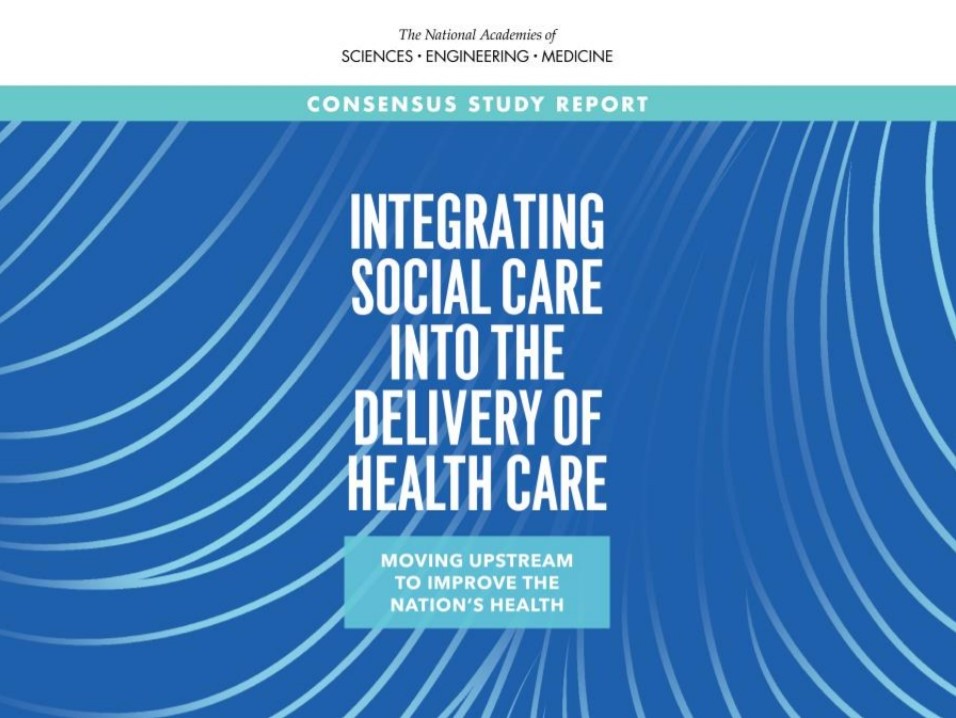
A recent report from the National Academies of Science, Engineering, and Medicine (NASEM), supported by Archstone Foundation and others, examines and documents the potential for integrating social services into the delivery of health care with the ultimate goal of achieving better and more equitable health outcomes.
The expert consensus committee that wrote the report looked at how social services that address social determinants of health—conditions in the places where people live, learn, work, and play that affect a wide range of health risks and outcomes—can be integrated into clinical care. They also examined what kind of infrastructure is necessary to facilitate integration.
The report, “Integrating Social Care into the Delivery of Health Care: Moving Upstream to Improve the Nation’s Health,” found that challenges facing the U.S. include financing the integration of social care with health care, defining the activities to be considered as social care, and identifying the best ways to pay for social care.
Perhaps this is easier said than done. But if not now, when? In just 10 years, when there are 8.4 million people 65 and older in California? Or in 15 years, when there are 77 million people 65 and older living in the U.S.?
The time to act is now. In recent years, we have seen movement from a “fee for service” health care model (providers are paid for services) toward “value-based care” (providers are paid based on health outcomes). The tide is turning, with growing active interest from multiple sectors converging with growing recognition of the need for better care.
A Roadmap for Integrating Social Services into Health Care Delivery
The report identifies and assesses current and emerging approaches and offers five overarching goals and accompanying recommendations that health care systems, government agencies, community-based organizations, and funders can use as a roadmap to better integrate patients’ social needs into health care delivery. They include:
- Design health care delivery to integrate social care into health care, guided by five health care system activities—awareness, adjustment, assistance, alignment, and advocacy. For instance, organizations should make and communicate a commitment to addressing health-related social needs at both the community and individual levels.
- Build a workforce to integrate social care into health care delivery. For example, the scope of practice of social care workers should be expanded and standardized, and they should be considered providers who are eligible for reimbursement by payers.
- Develop a digital infrastructure that is interoperable between health care and social care organizations. For instance, the federal government should establish a large-scale social care digital infrastructure and provide resources so that organizations that provide social services, as well as consumers who use them, can interact with each other and with the health care system.
- Finance the integration of health care and social care. For example, the Centers for Medicare & Medicaid Services should clearly define which aspects of social care Medicaid can pay for as a covered service.
- Fund, conduct, and translate research and evaluation on the effectiveness and implementation of social care practices in health care settings. For instance, federal and state agencies, payers, providers, delivery systems, and foundations should contribute to advancing research on and evaluating the effectiveness and implementation of social care practices.
For decades, the nationwide Aging Services Network has played an important role in providing social services. More recently, health care organizations have begun to understand how social determinants of health impact the health outcomes they seek. While this new awareness is coming to the fore, the reality is that health systems, payers, aging services and community-based organizations must come together to address social determinants such as housing, nutrition, education, transportation, and social isolation in order to improve the nation’s health.
It’s time to follow the lead of, and learn from, the aging service network and the communities they serve to address social factors that contribute to illness, poor health and mental health care outcomes.
As a country we have a ways to go, but the report offers a roadmap to better integrate patients’ social needs into the delivery of health care.
As a people, the rest is up to us.
Supporters of the study include: Archstone Foundation; the Association of Oncology Social Work; Bader Philanthropies; Chicago Community Trust; Community Memorial Foundation; Council on Social Work Education; Episcopal Health Foundation; Health Foundation for Western and Central New York; Healthy Communities Foundation; The Helen Rehr Center for Social Work Practice; Josiah Macy Jr. Foundation; Kaiser Permanente National Community Benefit; National Association of Social Workers (NASW) and the NASW Foundation; New York Community Trust; Robert Wood Johnson Foundation; The SCAN Foundation; and Society for Social Work Leadership in Health Care. Additional support was garnered from Boston University Center for Innovation in Social Work and Health social work academic program match campaign.
To download the full report, visit Archstone Foundation’s Publications page.