
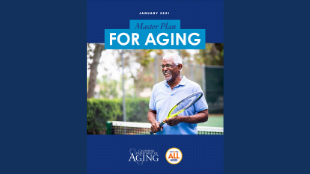
Following an intensive and inclusive 18-month planning and engagement process, California’s Master Plan for Aging provides a bold blueprint for aging across the lifespan in the most populous state in the nation.
However, with the public release of the Plan in January 2021, the real work is just beginning. The Plan is intended to be a “living document” that identifies five “bold” goals, 23 strategies and a rough measurement framework. It also includes a Local Playbook to drive partnerships that will help us meet these goals together.
The Plan represents a 10-year commitment to improving how we all age in California. It calls on state and local government, businesses, philanthropy, and others to ensure that the changing landscape for California’s 10.8 million older adults in 2030, and their caregivers, is planned for in partnership and with older adults' well-being in mind.
Archstone Foundation is proud to be part of this important work, as one of the eight foundations that entered into a funders collaborative and a Memorandum of Understanding with the state to support the development and implementation of the Master Plan after Gov. Gavin Newsom issued an Executive Order in June 2019 calling for the plan’s creation. The other participating foundations were Gary and Mary West Foundation, Irvine Health Foundation, Metta Fund, Rosalinde and Arthur Gilbert Foundation, The SCAN Foundation, The San Diego Foundation, and May and Stanley Smith Charitable Trust.
As called for in the Executive Order, a Stakeholder Advisory Committee (SAC), a Long-Term Services and Supports Subcommittee, and a Research Subcommittee were formed in August 2019 comprised of 78 members from local government, health care providers, health plans, employers, community-based organizations, academia, researchers, and consumers. As a core funder of the process, Archstone Foundation was able to nominate Board of Directors member Heather Young to serve on the SAC. In addition, Chris Langston, President and CEO of Archstone Foundation, served on the Research Subcommittee of the SAC and I had the honor of serving on the public-private liaison committee.
Ready for Action
To begin moving toward the vision of improving aging in California over the next decade, the Plan proposes more than 100 “action-ready” initiatives for leaders in government, business, philanthropic, and community-based organizations to collaborate on creating age-friendly communities for all Californians. These initiatives have been further specified in Gov. Newsom’s initial 2021-2022 budget proposals released on January 8. If ultimately approved, they represent promising first steps in the Master Plan’s implementation.
Aging-related initiatives that would get new funding under the budget proposal for 2021-2022 are:
- Master Plan Placeholder - $5 million for further implementation
- Aging Services Network - $7.5 million Aging and Disability Resource Centers – No Wrong Door Statewide Referral
- Geriatric Care Workforce - $3 million through Office of Statewide Health Planning and Development
- Alzheimer’s - $17 million
- Public Education - $5 million
- Training and Certification of Caregivers - $4 million
- Training in Standards of Care for Health Care Providers - $2 million
- Dementia Friendly Community Grants - $2 million
- Research “Leadership” Infrastructure - $4 million
- In-Homes Services and Supports “Back Up” provider wage differential - $5.3 million
Regular Program Renewals (in addition to withdrawing previously proposed program cuts, e.g., to IHSS, Medi-Cal Supplemental Benefits, etc.) include:
- Adult Day Health Centers (AKA C-BAS) - $5.8 million
- Multipurpose Senior Services - $23.6 million
- Long-term Care Ombudsman - $17.4 million
- Health Insurance Counseling and Advocacy (HICAP) - $13.6 million
In addition, some related initiatives in the budget proposal include:
- Purchase Adult Residential Facilities (Board and Care) for seniors facing homelessness - $250 million
- Telehealth in Medi-Cal - $94.8 million
- Behavioral Health Grant Program Directed to Include Consideration of Older Adult Needs/Programs - $700 million
Some of the interesting, but at this point unfunded, initiatives include: Senior Advisor on Aging, Disability, and Alzheimer’s to the Governor; Office of Medicare Innovation and Integration – as part of Medi-Cal Redesign; and Statewide Focus on Health Information Exchange.
The budget items will be voted on in the May revise and we are hopeful that many will go forward in the final budget. These commitments go a long way toward realizing the vision laid out in the Master Plan for Aging.
How We Got Here
The Executive Order issued by Gov. Newsom affirmed the priority of the health and well-being of older Californians and the need for policies that promote healthy aging. It also called for a blueprint for state government, local government, the private sector, and philanthropy to prepare the state for the coming demographic changes and to continue California’s leadership in aging, disability, and equity.
Following creation of the SAC, Long-Term Services and Supports Subcommittee, and Research Subcommittee, what became the “Together We Engage Campaign” collected input from the public, stakeholders, and partners through pledges, surveys, meetings, webinars, and community roundtables between September 2019 and October 2020. The campaign was overseen by the California Department of Aging.
And in December 2019, the SAC formed an Equity workgroup tasked with insuring that equity is fully “baked in” to the Master Plan. The workgroup recognized the diversity of California’s population — both the strong and varied cultural traditions around aging, as well as the need to address life-long disparities and inequities faced by Black, Indigenous, and People of Color (BIPOC) and Lesbian, Gay, Bisexual, Transgender, Queer (LGBTQ), and other Californians..
Throughout the stakeholder engagement process, the committees and the administration received over 240 policy recommendation letters and over 1,000 public comments. The engagement process culminated in the SACs submission of an Equity Tool and Glossary, a Long-Term Services and Supports Stakeholders Report, a Livable Community and Purpose Stakeholder Report, a Health and Wellbeing Stakeholder Report, and an Economic Security, Safety, and Emergency Preparedness Stakeholder Report.
Over 800 Stakeholder Advisory Committee recommendations were provided to the administration to inform the creation of the final Master Plan for Aging. In addition, the recommendations of the separately chartered Alzheimer’s Task Force, led by Maria Shriver, were ultimately incorporated in the plan.
The Cabinet Work Group, representing all 10 cabinet departments and other executive offices, met throughout the Master Plan process to consider public and stakeholder input and provide expertise and strategic direction to the governor. The Master Plan spans multiple policy areas requiring coordination and integration across government to improve the delivery of programs and services that are centered on the needs of older Californians.
Taking all the raw input, the cabinet group processed and prioritized it and ultimately released the Master Plan reflecting the administration’s views in January 2021.


Comments
Thank you. As a community volunteer I am grateful to have received this information about the master plan for aging. It makes a significant difference to understand the larger view. As a 78 year ear old, I feel extremely encouraged to be living in California at this time and deeply appreciate that first steps are already underway. Thank you for all you are doing.
Just one suggestion. In the plans for collaboration, I do not see homeless elders or housing insecure seniors included. The mantra of one of the groups I am involved in is “not about me without me.” The input and ideas of those most directly touched by the changes to come has to be invaluable. Perhaps I missed their place at the table and if so, excuse me. If, however, they do not have a role in the work, I wonder why not?
Thank you again for all the work going on to make aging better. May all of it make a positive difference.
Sincerely,
Gail Steinberg.